SOURCE: www.loudwire.com
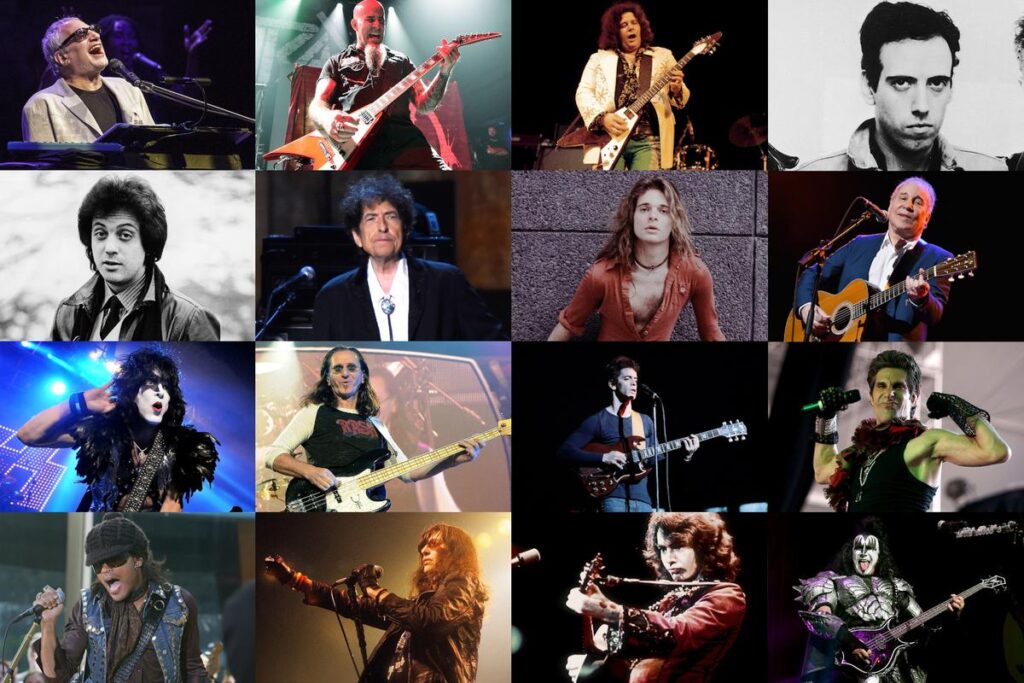
Some of the biggest rock stars in history happen to be Jewish, either by birth or conversion.
Given the rich musical tradition of the Jewish people, this should hardly come as a surprise. Songs are used in celebration, in times of happiness and in times of sorrow. Holy scriptures are shared out loud in a chanting presentation, rather than simply being spoken.
Rabbi Nachman, a prominent historical figure in the movement of Hasidic Judaism, once said that “melody is the refinement of the spirit, separating human-spirit from animal-spirit.”
Many rock stars raised in the Jewish culture have noted how their upbringing influenced their career path. Art Garfunkel and Trevor Rabin of Yes were among the future rockers who got their taste of performing by singing at their local synagogue. Meanwhile, David Lee Roth saw his success in Van Halen as an opportunity to break down traditional Jewish stereotypes.
Of course, not every Jewish rocker remained close to their faith. Lou Reed, Billy Joel and the Melvins’ Buzz Osborne are among those who’ve openly admitted detachment from the culture. Then, there’s the case of the Band’s Robbie Robertson. He didn’t discover he was Jewish until he was about 12 years old, when his mother revealed the identity of his birth father.
In “The Chanukah Song,” comedian Adam Sandler famously rattled off a long list of Jewish celebrities from throughout music and entertainment. We don’t have the talent to write a song of our own, so instead we’ve highlighted 40 Jewish rock stars below. One name you won’t find on the list? Saul Hudson, aka Slash. The Guns N’ Roses guitarist – who was born to a Black American mother and White British father – has long dispelled rumors that he has Jewish heritage.
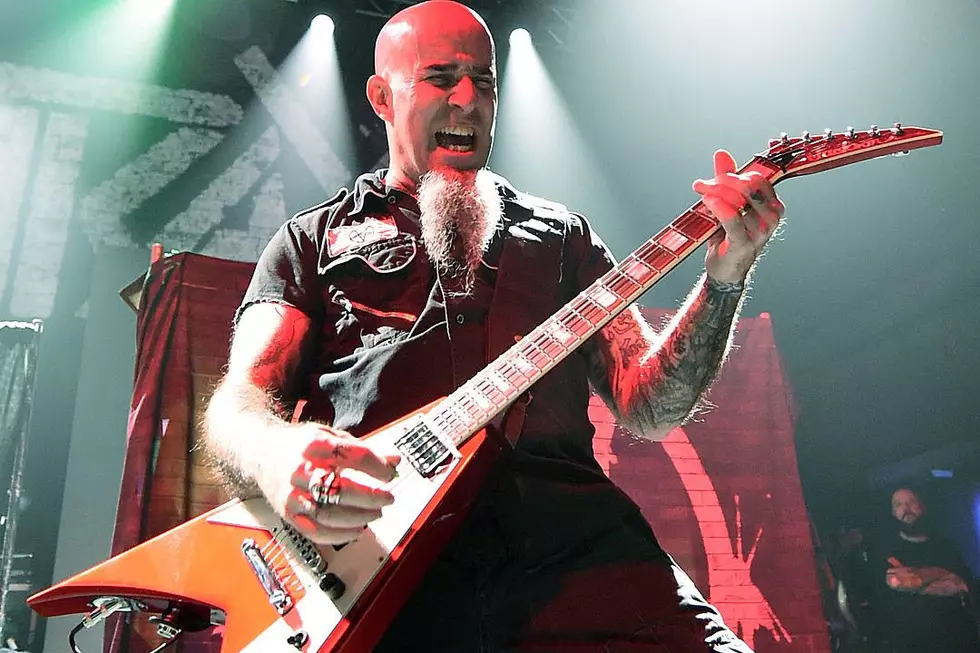
Scott Ian
Though Anthrax guitarist Scott Ian was born into a Jewish family, his parents were all encompassing with their holiday traditions. “We had a Christmas tree every year,” he admitted in 2011. “We had a Seder. We had Rosh Hashanah. We’d go to Florida every Passover, to my grandparents.” Though he doesn’t consider himself to be a practicing Jew, Ian takes umbrage when people suggest metal music and Judaism don’t mix: “Jews are tough people. People think of Jews as the Woody Allen stereotype, the nebbishy kind of thing, but that’s not the kind of Jews I know. I know plenty of Israelis and plenty of tough guys that are Jewish. So, I think it makes sense that Jews play metal.”
Kevin Winter, Getty Image
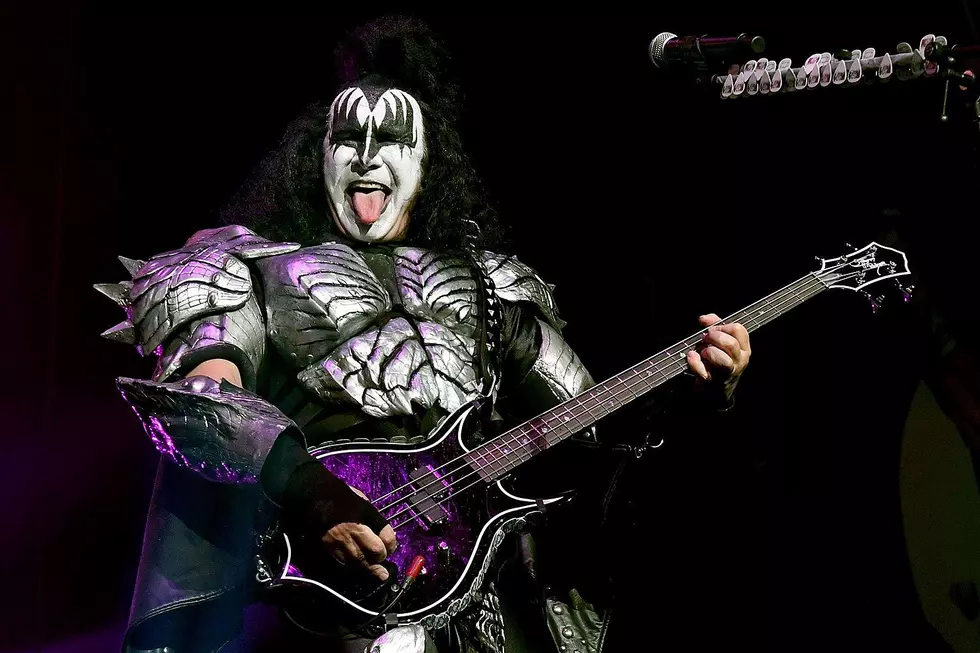
Gene Simmons
Kiss co-founder Gene Simmons was born Chaim Witz in Haifa, Israel but changed his name to Eugene Klein when he moved to the U.S. at the age of nine. Simmons’ mother, a Hungarian immigrant, was the only member of her family to survive the Holocaust. Simmons said he changed his name for his career, while always maintaining a reverence for his heritage. “I was born Chaim Witz, and I understood that that didn’t work — I did,” he explained during a 2022 appearance on the Howie Mandel Does Stuff podcast. “I realized for myself that in order to succeed, I’ve gotta be a chameleon of sorts. Basically, dress British, think Yiddish. Yeah, you’re Jewish. That’s fine. Shut the fuck up. Nobody’s interested.”

Jim Dyson, Getty Images
Paul Stanley
Kiss co-founder Paul Stanley was born Stanley Harvey Eisen in 1952. His Jewish mother and her family fled Nazi Germany before coming to America. “That’s something I hold dear to me and have a very strong feeling of obligation to make sure that my children understand Judaism and the Holocaust,” he told the Philadelphia Jewish Exponent in 2018. “I grew up with adults around me with numbers on their arms. That was part of my life. So my sense of duty is to instill in my children my heritage.”

Ethan Miller, Getty Images
David Draiman
Disturbed singer David Draiman may have been expelled from Yeshiva during his childhood, but one-time troublemaker has since become one of the biggest advocates against antisemitism in all of music.
He was born in Brooklyn and raised by Jewish parents and his studies continued after his expulsion from school, spending a year at two institutions near Jerusalem.
In June of 2024, the singer received a join award from Jerusalem Post and the World Zionist Organization for Outstanding Contribution to the Fight Against Antisemitism.
Frazer Harrison, Getty Images
Bob Dylan
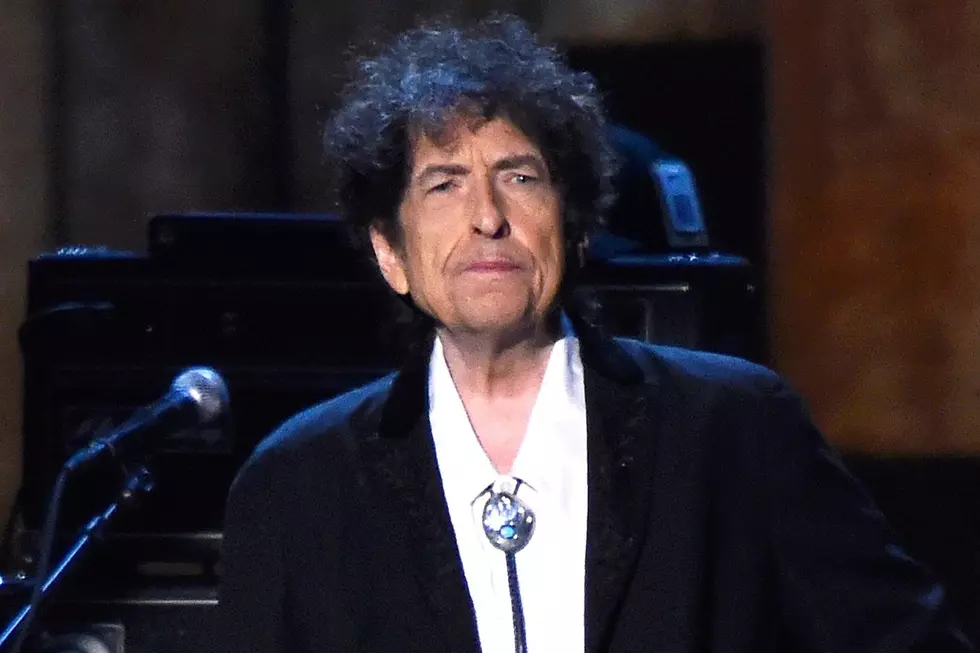
Bob Dylan has perhaps the most twisting and interesting relationship with Judaism of any rock star on this list. His parents were both presidents of Jewish service organizations and Dylan’s extended family included Yiddish-speaking grandparents. He supposedly spent four summers at a Jewish sleep-away camp and his music confirms a deep knowledge of Jewish traditions and teachings. Yet he rejected his Jewish heritage once he changed his name from Zimmerman to Dylan. He became a believer in Jesus Christ, professing himself a Christian in the late ’70s. Since then, however, he has re-found Judaism and now is considered a committed Jewish Christian.
David Tan/Shinko Music, GettyImages
David Lee Roth
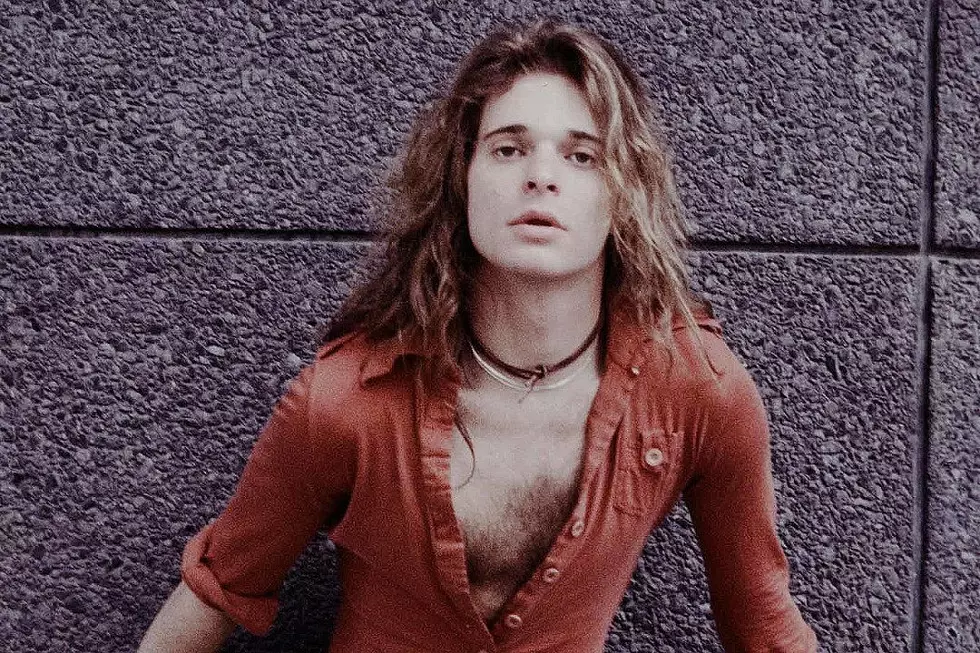
David Lee Roth is half-Jewish on his father’s side and was raised in the Jewish religion, apparently learning to sing by studying for his bar mitzvah. As a proud Jewish rock star, the future Van Halen frontman kept his last name, unlike many of his peers in the music business. Being raised on the chutzpah and showmanship of performers like Al Jolson likely contributed to Roth’s colorful stage presence years later. “Much of his style and energy came from fury over anti-Semitism and an urge to crush Jewish stereotypes,” the Washington Post noted in 2003. Roth confirmed as much, admitting he wanted to be a different kind of role model. “There’s not a lot of Jewish action figures,” Roth explained. “Heroes for little Jewish kids are very few and far between.”

Richard E Aaron/Redferns, Getty Images
Lou Reed
Lou Reed was born in Brooklyn, N.Y. in 1942, his father having changed their family name from Rabinowitz. He grew up with strict conservative Jewish parents, and in adulthood separated himself from organized religion. Instead, the Velvet Underground frontman found another kind of salvation. “My God is rock ’n’ roll. It’s an obscure power that can change your life,” he once declared. “The most important part of my religion is to play guitar.”

Mackie Osbourne
Buzz Osborne
Melvins frontman Roger “Buzz” Osborne (aka King Buzzo) is a mixed bag, with English, Italian and Jewish lineage. As such, Osborne says he doesn’t subscribe to any religious or cultural sect. “I’m not part of any of that. I don’t feel any kinship towards any [religions],” he told Kyle Meredith in 2020. “I am Jewish, English and Italian. When I go to any of those places do I feel like, ‘I’m home! This is where my people come from.’ No! That’s not it. I’m not home in any of those places. I don’t feel a kinship toward any of those people because of what’s happened to them. I have my own experience, living my own life in my own world.”

Bill Tompkins, Getty Images
Josh Silver
Type O Negative keyboardist, producer and backing vocalist Josh Silver was raised Jewish, however he identifies as atheist. As you’d expect, playing in a goth metal band presented conflicts with his upbringing. For example, in 1991 Type O Negative was accused of being Nazis. Silver rejected the suggestion, though he appreciated the “great publicity” it brought the band. In interviews, he pointed to his Jewish heritage as one of several reasons the rumors were false.

Ed Caraeff / Morgan Media, Getty Images
Neil Diamond
The son of Jewish immigrants, Neil Diamond was actually given the nickname “Jewish Elvis.” He began singing when he was in school and at one point was in the same choir as another future star, Barbara Streisand. In a career spanning more than 60 years, Diamond has delivered a bevy of hits, including “Sweet Caroline,” “Cracklin’ Rosie,” “America” and “You Don’t Bring Me Flowers” – a duet with Streisand. Diamond has sold more than 100 million albums in his career and was inducted into the Rock & Roll Hall of Fame in 2011. “I am Jewish. I believe in God, love the traditions I learned growing up, and tend to be very spiritual,” he stressed in Diamond: A Biography.

Hulton Archive, Getty Images
Billy Joel
Jewish by birth, Joel will be the first to admit that he’s Jewish only by heritage and that his family was never observant. His parents were both from Jewish families but he was not brought up in any religious way. Families who survived the Holocaust often tried to bury their Jewishness and this was the case with the Joels. In Mark Bego’s book Billy Joel: The Biography, Joel quipped that “my circumcision was as Jewish as [his parents] got.”

Eric Haggard, UCR
Steven Adler
Born Michael Coletti, drummer Steven Adler is the son of an Italian-American father and a Jewish American mother. His mother changed his name after his father left the family, and when she remarried Steven took on his step-dad’s surname. Adler became friends with Saul Hudson (aka Slash) in junior high school, and the two joined forces in Guns N’ Roses beginning in 1985. Adler was part of the group’s classic lineup, performing on 1987’s Appetite for Destruction and 1988’s G N’ R Lies. Being in the biggest band on the planet came with plenty of temptations, however, and Adler spent many years battling drug addiction. He was fired in 1990, and it took decades for the drummer to get his career – and life – back on track.
Theo Wargo, Getty Images
Paul Simon
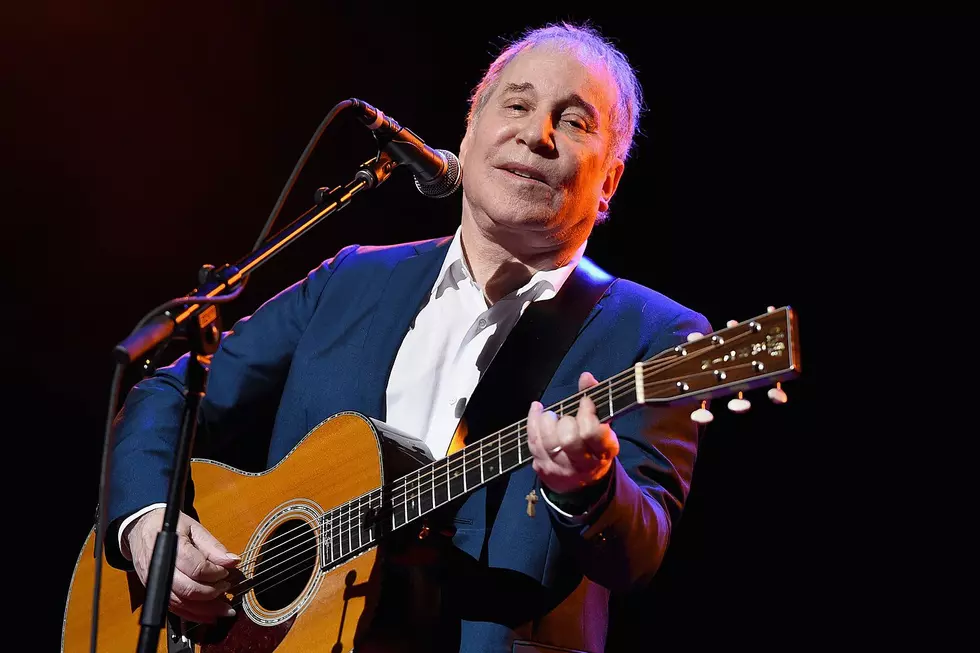
Paul Simon was born on Oct. 13, 1941, in Newark, N.J., to Hungarian-Jewish parents. He got his first taste of stardom when the song “Hey Schoolgirl” – recorded with Art Garfunkel in the duo Tom & Jerry – became a minor hit. Still, Simon initially believed he was destined to be an attorney. Two years after his bar mitzvah, Simon entered Queens College expecting to graduate and go on to law school. Instead, the draw of music proved too much to ignore. With more than 100 million albums sold, 16 Grammys and an induction into the Rock & Roll Hall of Fame, it seems he made the right choice.

Mike Lawrie, Getty Images
Pat Smear
Born Georg Albert Ruthenberg, Pat Smear would co-found the influential punk group the Germs, then serve as a touring guitarist with Nirvana and as a key member of the Foo Fighters. He’s half-Jewish by way of his Jewish-German immigrant father, and was surrounded by various religious and cultural influences during childhood. At 13, Smear reportedly ran away from home to join a religious commune. The Germs went on to become underground stars on the Los Angeles music scene, but split after frontman Darby Crash died of a heroin overdose. Smear later latched on with Nirvana, whose history ended in similarly tragic fashion. He’s enjoyed two stints in Foo Fighters, one from 1994-1997 and another beginning in 2005.

Kevin Winter, Getty Images
Art Garfunkel
The singing career of Arthur Ira Garfunkel began when he was just seven years old, performing at his family’s Queens, N.Y. synagogue. The budding vocalist began regularly singing with his rabbi on Saturday mornings, and later performed as a cantor during his own bar mitzvah. He’d team up with classmate Paul Simon in Tom & Jerry, the singing duo that lasted from 1956 to 1962. After a year apart, they’d reconvene at Simon & Garfunkel in 1963, launching a legendary partnership that included such hits as “Mrs. Robinson,” “The Sound of Silence” and “Bridge Over Troubled Water.” This relationship was far from perfect, as the duo had multiple acrimonious splits, but Simon & Garfunkel remain one of the most revered acts in rock history.

Ethan Miller, Getty Images
Geddy Lee
Rush co-founder Geddy Lee was born Gary Lee Weinrib on July 29, 1953. His parents were Jewish refugees from Poland who survived the Dachau and Bergen-Belsen concentration camps during World War II. Lee once told Rob Tannenbaum of Blender that the two most Jewish things about him are “my nose and my sense of humor. I’m kind of a Jewish atheist: I bathe in the racial beauty of Judaism, but I don’t really see what that has to do with a belief in God. The only time I pray is on the tennis court.”

Kristian Dowling, Getty Images
Perry Farrell
The world may know him as Perry Farrell, but he went by his Jewish birth name of Peretz Bernstein long before forming Jane’s Addiction. He’d admittedly held religion at a distance throughout his youth, and even “got kicked out of Hebrew school for making trouble,” but Farrell is very spiritual these days. He’s an adherent of Kabbalah, or Jewish mysticism, and regularly reads religious documents and interpretations. “I study and reflect on the teachings of the Torah every day,” he admitted in 2019. “It’s a living document to apply to our surroundings.”

Ethan Miller, Getty Images
Adam Lambert
Nobody will ever really fill the shoes of Queen frontman Freddie Mercury, but Adam Lambert has done a commendable job since he started singing with the group in 2011. The American Idol runner-up was raised in a mixed-faith household and attended Hebrew school as a child before dropping out around age nine. “We did celebrate Chanukah as opposed to Christmas,” Lambert told the Jewish Journal. “So we stayed true to our roots that way. And we celebrated Passover occasionally. I mean, I hate to say it, but we were kind of Jewish by form. Lightly Jewish. Diet Jews. More of a heritage thing.”

Jorgen Angel, Getty Images
Leslie West
Leslie Weinstein was better known as Leslie West, guitarist, singer and co-founder of Mountain. West changed his surname after his parents divorced and used it throughout his career. Though raised by Jewish parents, West never subscribed to organized religion. “I’m not a religious guy, man,” he admitted to Goldmine in 2016. “For me, though, the music, that’s my church, so to speak. Except I haven’t gone to confession lately.”

Gie Knaeps, Getty Images
Joey Ramone
Jews were instrumental in the rise of punk music in America, and at the center of the movement was the Ramones. Frontman Joey Ramone was born Jeffrey Ross Hyman. His parents met in the Borscht Belt, a famous collection of summer resorts in the Catskill Mountains where Jewish families regularly vacationed. Joey co-founded the Ramones in 1974 and was one of the band’s two Jewish members, along with Tommy Ramone. The Ramones cut their teeth at New York’s famed CBGB’s, a Jewish-owned venue. In 2005, Ramone was honored posthumously at the first Jewish Music Awards, receiving the Heeb Magazine Lifetime Achievement Award.

Steve Wood, Getty Images
Marc Bolan
T-Rex lead singer and guitarist Marc Bolan was born Mark Feld. His father was a truck driver of Polish-Russian Jewish descent and though Marc was raised Jewish, he was technically only half-Jewish. Still, Bolan was proud of his heritage. In recognition, John Zorn spearheaded a 1988 tribute album called ‘Great Jewish Music’ that featured many artists covering T-Rex songs as part of the ‘Radical Jewish Culture’ series.

Michael Putland, Getty Images
Peter Green
Peter Allen Greenbaum became known to the world as Peter Green, co-founder of Fleetwood Mac in 1967. He got his first break in John Mayall’s Bluesbreakers, helping the group develop a devoted following in the U.K. When he splintered off to start his own band, Green recruited two Bluesbreakers to join him: Mick Fleetwood and John McVie. Drug addiction and mental health issues would later crumble Green’s promising career. He left Fleetwood Mac in 1970 and only recorded sporadically until his death in 2020.
Adam Bettcher, Getty Images
Daryl Hall
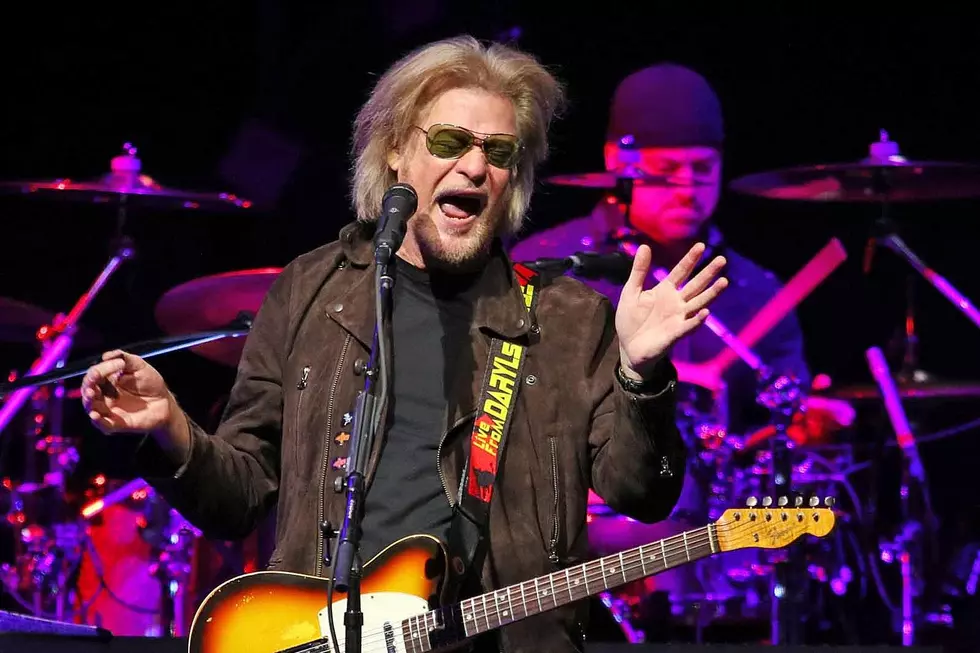
Blue-eyed soul singer Daryl Hall was born into a Methodist family, but he converted to Judaism in 1969 to marry his first wife, Bryna Lublin. The marriage was over by 1972, but Hall stayed connected to his adopted religion. “[Judaism] became a part of my life. I wasn’t married to her very long, but Judaism still gives me an understanding of life,” Hall said in a 2010 conversation with Heeb. As half of Hall & Oates, he enjoyed an impressive run of success starting in the ’70s and ‘80s. The duo scored six No. 1 hits – “Rich Girl,” “Kiss on My List,” “Private Eyes,” “I Can’t Go for That,” “Maneater” and “Out of Touch” – and scored another 10 singles in the Top 10.

Hulton Archive, Getty Images
Mick Jones
The Clash guitarist Mick Jones is half-Jewish, born to a Welsh father and a Russian Jewish mother. He spent many of his formative years living with a maternal grandmother who had fled Russia during the Pogroms, the series of anti-Jewish mass executions in the late 1800s and early 1900s. When Jones co-founded his pre-Clash group London SS in 1975, he hid it from his family. Though he later insisted the band’s name had nothing to do with the German paramilitary force known as the SS, Jones recognized the inflammatory nature of the title. “We were young and stupid,” he admitted in 2008, adding that looking back on it made him “cringe.”

Phil Dent / Redferns, Getty Images
Mark Knopfler
Dire Straits frontman Mark Knopfler is another half-Jewish rocker, born to an English mother and a Hungarian Jewish father. He bounced around various bands through the ‘60s and most of the ‘70s before founding Dire Straits in 1977 alongside his younger brother, David. The group scored a number of hits over the ensuing decade, including “Sultans of Swing,” “Money for Nothing” and “Walk of Life.” Dire Straits went on to sell more than 120 million albums worldwide, and earned induction into the Rock & Roll Hall of Fame in 2018.

Ernest Haas
Robbie Robertson
The Band’s Robbie Robertson was raised by his mother Rosemarie and father James. The couple split when Robertson was a teenager, at which point Rosemarie revealed that Robbie’s biological father was actually David Klegerman, a Jewish man she had been with while James was stationed with the Canadian Army. Robertson was eventually introduced to his biological family, who happened to be members of Toronto’s Jewish underworld. “They brought me into their world with tremendous love and affection,” Robertson noted in the documentary Once Were Brothers, adding that he’d occasionally run “errands” for his uncles. Still, Robertson didn’t stray too deeply into the Klegermans’ business. Instead, he focused on music, forging a career spanning more than 50 years that has included his celebrated tenure with the Band, solo material and film soundtrack work.

Ethan Miller, Getty Images
Mickey Hart
Born and raised in a predominantly Jewish area of New York, Mickey Hart was born Michael Hartman before admittedly lapsing following his bar mitzvah. Still, that didn’t stop the Grateful Dead drummer from celebrating Passover while on tour. “That’s right, it was at Nassau Coliseum in Long Island and at Madison Square Garden,” Hart told The Jerusalem Post, looking back on his days with the Dead. “We had communal Seders, with everybody joining in. We even had a rabbi there.”

Matthew Peyton, Getty Images
Lenny Kravitz
Lenny Kravitz’s father Sy was of Russian Jewish ancestry, while his mother Roxie Roker was of African-American and Bahamian descent. As you’d expect, he was raised to celebrate his various cultural backgrounds. Kravitz is Christian, but his father instilled in him a respect for his Jewish heritage. “He wasn’t religious,” Kravitz told The New York Times in 2020. “As with many Jews in my family at the time, it was all about tradition and keeping that alive, especially after what people in the family had gone through in World War II. But I still got exposed to [the religion], from going to temple and spending the High Holidays with my family at their houses.”

Craig Barritt, Getty Images
Rick Rubin
Producer Rick Rubin was born Frederick Jay Rubin and raised in an upper class Jewish family on Long Island, New York. The music entrepreneur started Def Jam Records during his senior year of high school. By the mid-’80s, he was helping release some of the most influential albums in rap history. But Rubin’s tastes extend far beyond hip-hop, and he has helmed albums from some of the biggest names in rock history. Among them, Red Hot Chili Peppers, Slayer, Tom Petty, AC/DC, Johnny Cash and Joan Jett.

Santiago Felipe, Getty Images
Donald Fagen
Donald Fagen’s Jewish upbringing directly influenced his musical tastes, as the future Steely Dan co-founder found himself drawn to the broad spectrum of music surrounding him in New York. “All you had to do is turn on the radio and you could hear jazz and blues and soul music,” he told Tablet. “The whole musical generation of white kids in the ’60s was really based on their love of Black music. And it worked both ways because a lot of the tunes were by Jewish songwriters. We really liked guys like Jerry Ragovoy and Bert Berns, who co-wrote ‘Twist and Shout.’”

Kevork Djansezian, Getty Images
Max Weinberg
E Street Band drummer Max Weinberg has openly expressed his respect and dedication to his Jewish faith over the years. “Some of my earliest musical experiences took place at the synagogue,” Weinberg told the Jerusalem Post, noting how important Judaism was in his upbringing. “I have two older sisters and a younger sister. Between Hebrew school, Sunday school and services, I probably spent more time in the temple than I did any place else! My initial musical experiences performing took place there.”

Jacopo Raule, Getty Images
Chris Stein
Both of Chris Stein’s parents were Jewish, yet the future Blondie co-founder didn’t have much religion in his household growing up. “Both of them were ‘reds’,” Stein told the Jewish Chronicle in 2011, describing his parents’ membership in the Communist party. “They had met in the party so my Jewishness was limited. They were more atheistic in their views, and I didn’t have a bar mitzvah – although, of course, I had plenty of relatives who were practicing. In retrospect, I wish I knew a little more Hebrew. My father used to speak Yiddish with my grandfather quite fluently. I love listening to Lenny Bruce; I admire his ability to make Yiddish sound cool.”

Ethan Miller, Getty Images
Bruce Kulick
Add another Kiss alumnus to the list! The guitarist was born in Brooklyn, New York and attended Hebrew school. He spent 12 years in Kiss from 1984 to 1996. At the time, some people mistakenly claimed the group had an all-Jewish lineup, but Kulick himself pointed out that wasn’t the case. “That’s not really correct because there was no Jewish drummer in the band,” Kulick explained to the Jewish Journal. “Eric [Singer] kind of has a German name, his actual name, but he’s not Jewish. Three of the band members were Jewish. But it’s kind of funny that Paul [Stanley] and Gene [Simmons] and I, we do get that heritage thing and there are certain things about it. Gene being a little different, being half-Israeli and half-Hungarian, where Paul’s parents and heritage were closer to my parents’. It really always just comes down to work ethic and music and the love of what you do. Those guys are extremely successful, and there’s a lot of really talented Jewish doctors, so I see them as doctors of music.”

Erica Echenberg/Redferns, Getty Images
Bob Kulick
As you’d expect, Bruce’s brother and fellow rocker Bob Kulick was also Jewish. Though uncredited, Bob contributed to three Kiss albums: Alive II, Killers and Creatures of the Night. He also played on Paul Stanley’s 1978 solo album and on his 1989 solo tour. Bob, who died in 2020, also worked with Meat Loaf, Alice Cooper and Lou Reed during his career.

Kevin Winter, Getty Images
Randy Newman
Randall Stuart Newman grew up in a Jewish household – not that he ever knew it. In fact, Newman was invited to a classmate’s cotillion at a nearby upscale country club when he was about eight years old, only to have the girl’s father call back and rescind the offer. “I’m sorry, Randy, my daughter had no right to invite you, because no Jews are allowed” at the club, the parent reportedly said. “That’s all right, sir,” Newman replied before hanging up the phone and turning to his own father. “Hey, dad, what’s a Jew?” These days, he doesn’t subscribe to any religion at all. Newman is “an atheist, until I really get sick,” he insists.

Frederick M. Brown, Getty Images
Trevor Rabin
Trevor Rabin’s grandfather, Gershon Rabinowitz, was a kosher butcher who immigrated to South Africa in the late 19th century. The family maintained Jewish traditions and regularly attended synagogue. “I was a good singer, and every Saturday morning I would sing in the choir, so it was a rich upbringing in that way,” Rabin told the San Diego Jewish Journal. “We also always looked forward to [Passover], because it was just a great party with the whole family.” He became a professional musician at 16, working with various artists and eventually becoming part of the successful South African rock group Rabbitt. Rabin latched on with Yes in 1983, remaining a member for more than a decade. His tenure coincided with Yes’ most commercially successful era, as Rabin co-wrote the chart-topping hit “Owner of a Lonely Heart.”
Michael Ochs Archives, Getty Images
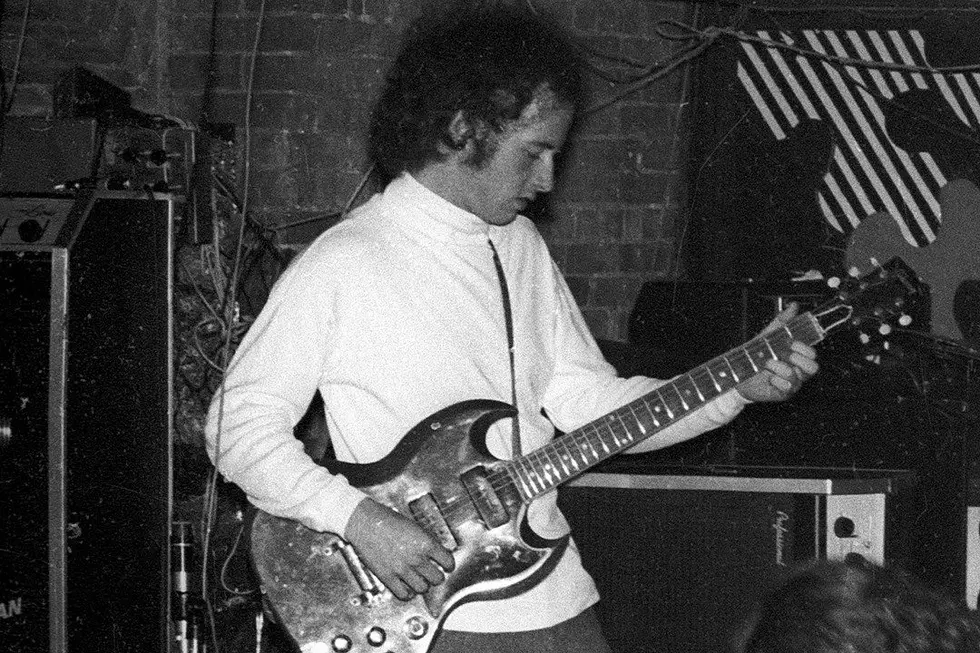
Robby Krieger
Robert Alan Krieger was born and raised in a Jewish family, though they tended to hide their religion from the Anglo-Saxons who made up the majority of their affluent Southern California neighborhood. Still, Krieger and his brother Ronny actually attended Hebrew school for a while – until they were kicked out for causing trouble. Neither boy had a bar mitzvah. “My parents kind of rebelled against the whole orthodox Jew thing because their parents were into it,” Krieger later told Guitar International. The guitarist joined the Doors in 1965 alongside keyboardist Ray Manzarek, drummer John Densmore and frontman Jim Morrison. They’d go on to have a legendary career, creating some of the most iconic rock of the ‘60s and early ‘70s.

Ron Pownall, Getty Images
Marty Balin
Martin Jerel Buchwald was born in Cincinnati in 1942. The son of a Jewish immigrant, he relocated to the Bay Area as a child. Later, Buchwald changed his name to Marty Balin as he pursued a career in music. He co-founded Jefferson Airplane in 1965, and the band found itself at the center of the era’s psychedelic-rock movement. They scored hits with “Somebody to Love” and “White Rabbit,” and played the Monterey Pop Festival and Woodstock. He left Jefferson Airplane in 1971, partially due to his bandmates drug habits (he didn’t partake) and partially due to his reduced role after Grace Slick’s emergence within the group. Jefferson Airplane’s various lineups featured three other Jews, including drummer Spencer Dryden and guitarists Paul Kantner and Jorma Kaukonen. Balin and Kantner were later in Jefferson Starship together.

Don Paulsen/Michael Ochs Archives/Getty Images
Al Kooper
Rock and Roll Hall of Famer Al Kooper was born into a Jewish family in Brooklyn, New York. The musician’s real name was Alan Peter Kuperschmidt, but he changed it for his professional career. A unique character in music history, Kooper was a member of Blood, Sweat & Tears and even gave the band its name, but he departed before the group enjoyed mainstream success. Kooper was also a manager and producer for Lynyrd Skynyrd, helming the band’s first three albums. He additionally worked as a session musician, collaborating with Bob Dylan, Stephen Stills and the Rolling Stones, among many others.

Don Paulsen/Michael Ochs Archives, Getty Images
Mike Bloomfield
Hailed as one of rock’s greatest guitarists, Mike Bloomfield was born and raised in a wealthy Jewish family. Bloomfield was revered as a leader of Chicago blues, and enjoyed great success beginning in the ‘60s. He collaborated with a wide array of musicians in his career, most notably Bob Dylan. He was also a member of the Paul Butterfield Blues Band, with whom he was posthumously inducted into the Rock and Roll Hall of Fame in 2015.